Our Blog

When Clear Aligners aren’t the Answer

September 28th, 2022

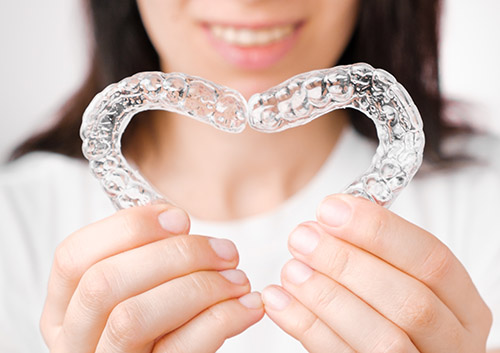
Clear aligners like Invisalign® have become increasingly popular over the past several years and rightly so. They’re removable, easier to clean than braces, and hardly anyone knows you're wearing them. They are great in treating many cases, but they aren't for everyone.

Below, Dr. Viney Saini and our team cover some of the instances where clear aligners just aren't the answer:

  • If drastic tooth movement is required – Fixed appliances deliver much more significant tooth movement. So if your case is a drastic one, clear aligners may not be the best choice.
  • If you need to move molars – Molars have much stronger roots than your other teeth and would require significantly longer to move with clear aligners. A fixed appliance is the best choice in this instance, especially if you have a substantial overbite or underbite that needs to be dealt with.
  • If you're the type who often forgets or loses things –If you would forget to wear your aligners for the prescribed amount of time (usually at least 22 hours per day), clear aligners are probably not the best choice for you. Forgetting to wear them can delay treatment and even make it so you need to regress to the previous set of aligners to be able to move forward with treatment. And let's face it, if you're not careful, removable aligners are easy to lose. Losing aligners delays treatment and is expensive since you need to buy replacements to stay on course. Replacing a lost set of aligners usually takes between seven and ten days—a definite setback in treatment.
  • If you're looking for the fastest treatment possible – Clear aligners usually can't move teeth as quickly as fixed appliances. So if you're looking for the fastest way to achieve your desired result, clear aligners may not be the best bet.

Feel free to talk with Dr. Viney Saini about your options regarding braces and clear aligners. We know there are pros and cons to both, so let’s find the option that works best in your life and for your specific needs in terms of treatment. Schedule an appointment at our Clarksburg, MD and Frederick, MD office today!

Common Malocclusions

September 21st, 2022

When we think orthodontics, we commonly think teeth. Naturally! Straight teeth and a beaming smile are everyone’s orthodontic goal. But orthodontics is a field which specializes in more than misaligned teeth. While your beautifully aligned teeth are the visible outcome of your orthodontic work, a properly aligned bite is the foundation for your healthy smile.

A malocclusion occurs when the teeth and jaws aren’t properly aligned—they don’t fit together the way they should when the mouth is closed. A malocclusion, or bad bite, affects many people to some degree, but not always in exactly the same way. Some of the different types of malocclusion include:

  • Crossbite

A crossbite occurs when upper teeth fit inside lower teeth. An anterior crossbite refers to the front teeth, with one or more upper front teeth, or incisors, fitting behind lower front teeth. A posterior crossbite affects the back teeth, with upper teeth fitting inside the lower teeth on one or both sides of the jaw.

  • Crowding

When the jaw is small and/or the teeth are large, lack of space can result in crowded, twisted, or crooked teeth.

  • Open bite

An anterior open bite means that the front teeth don’t close when biting down, leaving an open space between the upper and lower teeth. A posterior open bite occurs when the back teeth don’t make contact when the front teeth close.

  • Overbite

Our upper front teeth naturally overlap the lower ones a small bit when the teeth are closed. An overbite occurs when the upper teeth significantly overlap the lower teeth.

  • Overjet

When the upper front teeth protrude too far forward over the bottom teeth, it’s called an overjet, or, sometimes, buck teeth. Where an overbite causes a vertical overlap, an overjet takes into account the horizontal relationship of the teeth.

  • Spacing

A jaw that is large, teeth that are small, missing teeth—these conditions can lead to gaps between the teeth.

  • Underbite

An underbite results when the lower teeth and jaw extend further forward than the upper teeth and jaw, causing the bottom teeth to overlap the top teeth.

If you have a malocclusion, what comes next? This depends.

Some malocclusions are so minor that no treatment is necessary. Some are the result of misaligned teeth. Some occur because the upper and lower jaws are growing at different rates. Some are a combination of teeth and jaw misalignments. Some are caused by genetics, while others are caused by injuries or habits like prolonged thumb sucking or tongue thrusting.

Because malocclusions are so varied, your treatment plan will be designed for your specific needs. Braces, aligners, appliances like the Herbst® appliance or the palatal expander, surgery for severe malocclusions—there is a larger variety of treatment options than ever before to help you achieve a healthy bite.

When teeth and jaws don’t fit together as they should, the consequences can be damaged teeth and enamel, problems with the temporomandibular joint, headaches and facial pain, and difficulty chewing, eating, and speaking.

The good news is that early intervention for children can help correct teeth and jaw problems before they become more serious, leading to easier orthodontic care in the teen years, and helping to avoid the possibility of surgery or extractions. This is why Dr. Viney Saini and our team recommend an orthodontic assessment at our Clarksburg, MD and Frederick, MD office for children around the age of seven.

If you’re an adult with concerns about your teeth or bite, there’s good news for you, too. Dr. Viney Saini can devise a treatment plan to improve your bite and your smile no matter what your age.

Of course, despite our title, there’s really no such thing as a “common malocclusion” when we’re talking about your dental health. Each person—and each smile—is unique. Dr. Viney Saini will diagnose your malocclusion and create a personalized plan carefully tailored to your exact needs, for an uncommonly attractive, confident, and healthy smile.

Snacks that are Healthy for Your Body and Your Braces

September 14th, 2022

You know the school day’s over when you hear these seven little words: “I’m home! Is there anything to eat?”

And before your child got braces, you had the answer: simple, tasty snacks that provided not only an energy boost, but nutritional elements to help build strong teeth and strong bodies. But now whole carrot sticks and unsliced apples are out. Nuts and crunchy peanut butter? Not in your pantry. Hard cheeses and crunchy whole grain crackers? Also off the shopping list.

Because any foods that are crunchy, chewy, or hard to bite into can damage brackets and wires, it’s time to freshen up your go-to snack list. Luckily, Dr. Viney Saini can recommend many healthy and braces-friendly choices when children need something to tide them over until dinner.

  • Fruits and Vegetables for Vitamins and Minerals

Soft fruits like berries, melon, and bananas provide essential vitamins and minerals while going easy on your child’s braces. Make it a blended smoothie for a cool treat—you can even add a healthy handful of spinach or kale without interfering with that fruity taste. If your child still loves apples and carrots best, keep them on hand—but remember that thin slices are the only way to go.

  • Dairy Delivers Calcium

Cottage cheese, string cheese, and other soft cheeses provide essential calcium and vitamin D. Yogurt in all its many flavors is another great option.

  • Meats Provides Protein

Lean meats such as thinly sliced ham, chicken, or turkey provide flavor and protein, and don’t require the chewing that bologna, roast beef, and salami do. And nothing packs a protein punch like eggs—hard boiled, deviled, or diced up in egg salad.

  • Grains, Legumes, and Vegetables for Complex Carbohydrates

Complex carbohydrates—the “good” carbs—are important sources of energy for our bodies. Snacks such as hummus with soft whole grain pita wedges or blended black bean dip and soft crackers are a delicious, energizing option.

You are constantly looking for ways to make your children’s lives better. Mix and match any of these foods for a snack that’s not only good for their braces, but good for their teeth and bodies! Let us know your child’s favorite snack the next time you visit our Clarksburg, MD and Frederick, MD office!

Going Back to School with Braces

September 7th, 2022

Going back to school is already an exciting (and sometimes nerve-racking) time so we don't want your braces adding to that. Our Clarksburg, MD and Frederick, MD team has compiled some helpful tips to make the process as easy and fun as possible.

1. Make sure you pack or purchase braces-friendly lunches

Try to avoid overly crunchy foods (think carrots, celery, hard crackers) especially if your teeth are sore from having your braces tightened. But you shouldn't stop eating healthful foods that fall in this category. For instance apples can be sliced into wedges or carrots can be cut into coins.

You should also avoid sticky foods like candy or gum that can and will stick in your braces like glue! Softer foods are easier on your teeth and braces, so aim to make a good portion of your lunch on the softer side.

2. Have a braces kit in your backpack or locker

Having some useful items on hand at school when you need them is one of the most helpful things you can do. Pack some wax for sores or tenderness, floss and/or flossing tools made for braces, a toothbrush and toothpaste, a small cup for rinsing, a small mirror to check for trapped food, and some lip balm if your lips tend to chap. With these tools on hand, you'll avoid most if not all braces-related nuisances!

3. Know that you're not alone

If you're feeling self-conscious about your braces, don't. Be proud of them! There are many other people your age who have braces, and if they don't have them now, they probably will in the future. Relax and know that you're on the path to a straighter and healthier smile.

If you have any questions about making your transition into "braceshood," just ask Dr. Viney Saini or any member of our Clarksburg, MD and Frederick, MD team! We're here to help make your braces experience (and your smile) the best it can be.